HOW TO PAINT A CEILING
March 9, 2026 · 10 min read
Average ceiling
12x12 ft, two coats
Standard bedroom ceiling
~0.5 gal per coat
Best sheen for ceilings
Hides imperfections, no glare
Ceilings are painted first in every room for a reason — drips on the walls get covered when you paint the walls next. But ceilings are trickier than they look. You're working overhead, fighting gravity, and roller marks show under every light fixture. This guide covers the technique pros use to get a smooth, drip-free finish on flat, textured, bathroom, and vaulted ceilings.
CEILING PAINTING SUPPLY LIST
Ceiling paint (flat/matte)
MUST HAVE1 gal per 350 sq ft per coat
9" roller + extension pole
MUST HAVE3/4" nap for textured, 3/8" for smooth
2.5" angled sash brush
MUST HAVEFor cutting in edges and corners
Painter's tape (2" wide)
MUST HAVETape wall-ceiling line, fixtures
Canvas drop cloths
MUST HAVECover entire floor + furniture
Safety glasses + hat
MUST HAVEDrips are inevitable overhead
Stain-blocking primer
IF NEEDEDFor water stains or bare drywall
Step ladder (6 ft)
IF NEEDEDFor cutting in; pole handles rolling
Prep the Room
45-60 min
Ceiling painting is messier than walls — gravity works against you. Thorough prep now prevents hours of cleanup and protects your floors, furniture, and sanity.
Clear and cover everything
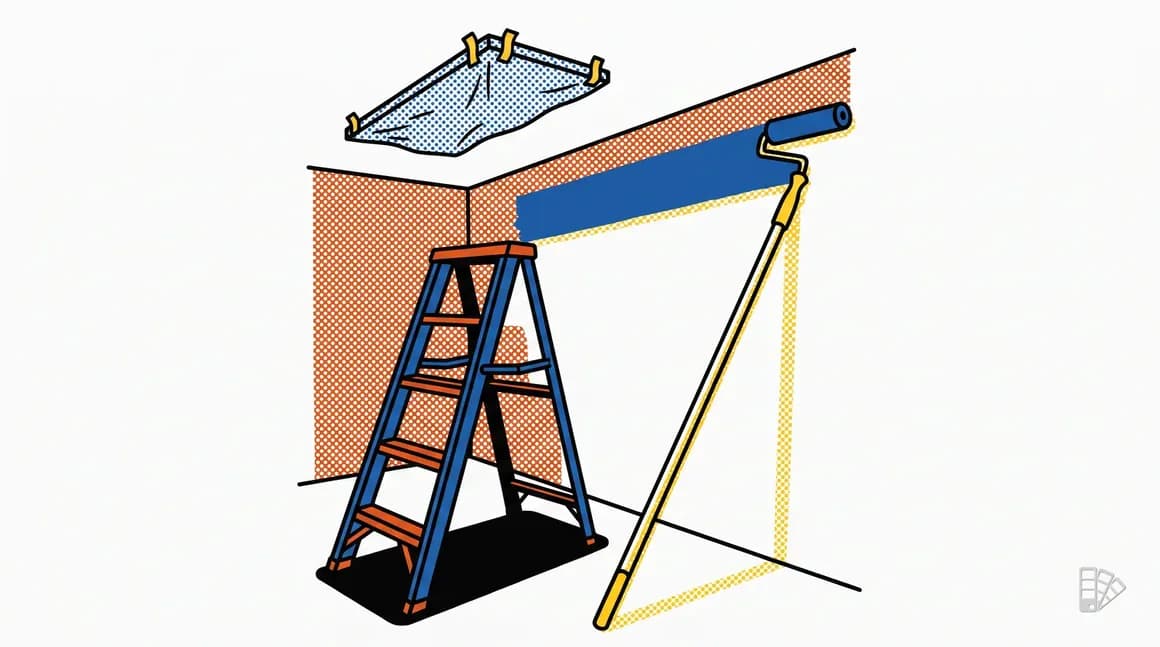
- Move all furniture out of the room. If it can't move, group it in the center and cover with canvas drop cloths — not plastic (paint pools on plastic and drips onto the floor when you bump it).
- Cover the entire floor with drop cloths. Ceiling drips will reach every corner of the room — partial coverage is not enough.
- Remove ceiling light fixtures and fan blades when possible. If a fixture can't be removed, wrap it tightly with painter's tape and a plastic bag.
Tape the wall-ceiling line
Apply 2" painter's tape along the top of every wall where it meets the ceiling. Press the edge firmly with a putty knife for a crisp seal. This is especially important if your walls are a different color than the ceiling.
Clean and repair
Dust the ceiling with a dry microfiber mop or vacuum with a brush attachment. Fill any cracks or nail pops with lightweight spackle, let dry 20 minutes, and sand smooth with 220-grit paper.
WATER STAINS
Brown rings on the ceiling mean past water damage. Fix the source first, then seal the stain with a shellac-based primer like Zinsser B-I-N before painting. Latex primer won't block the bleed-through.
Choose the Right Roller
5 min
The roller nap (thickness of the fabric sleeve) determines how much paint it holds and how it applies to your ceiling texture. Wrong nap = roller marks or poor coverage. Here is the breakdown:
Best for: Smooth drywall
Ultra-smooth, modern look. Less paint capacity — more reloading.
Best for: Lightly textured drywall
Slight texture, good coverage. Best all-around choice for most homes.
Best for: Textured / orange peel / knockdown
Gets into texture valleys. Recommended for most ceiling work.
Best for: Heavy texture / popcorn
Deep penetration into rough surfaces. Splatters more — work slowly.
PRO TIP
For most ceiling jobs, a 3/4" nap microfiber roller is the safest bet. It holds enough paint to maintain a wet edge across wide surfaces without dripping excessively. Pair it with a 4-6 ft extension pole so you can roll from the ground. If you need to figure out coverage, use our paint calculator to dial in the right amount.
Cut In the Edges
20-30 min
Cutting in means painting a 2-3 inch border with a brush everywhere the roller can't reach — corners, along walls, and around light fixtures. On ceilings, this step is critical because the wall-ceiling junction is the most visible edge in any room.
How to cut in overhead
- Use a 2.5" angled sash brush. The angled bristles let you paint a straight line while looking up at an angle.
- Load the brush about 1/3 of the bristle length. Tap (don't wipe) excess on the inside of the can.
- Start 1/2 inch from the wall-ceiling line, then slowly feather into it. This builds control before hitting the critical edge.
- Work in 3-4 foot sections. Cut in one section, then immediately roll that area before moving on. This prevents visible lap marks where brush and roller meet.
PRO TIP
Do not cut in the entire ceiling at once. If you brush all four edges and then start rolling, the brushed paint will dry before the roller reaches it. You'll see a visible "picture frame" effect — a band of different texture around the perimeter. Cut in one section, roll it, then move to the next. The same principle applies when painting trim and baseboards.
Roll the Ceiling
30-60 min
Rolling technique matters more on ceilings than walls. Gravity pulls wet paint downward, so uneven application shows immediately as sags, drips, and roller marks. Slow, deliberate passes are the key.
Rolling technique
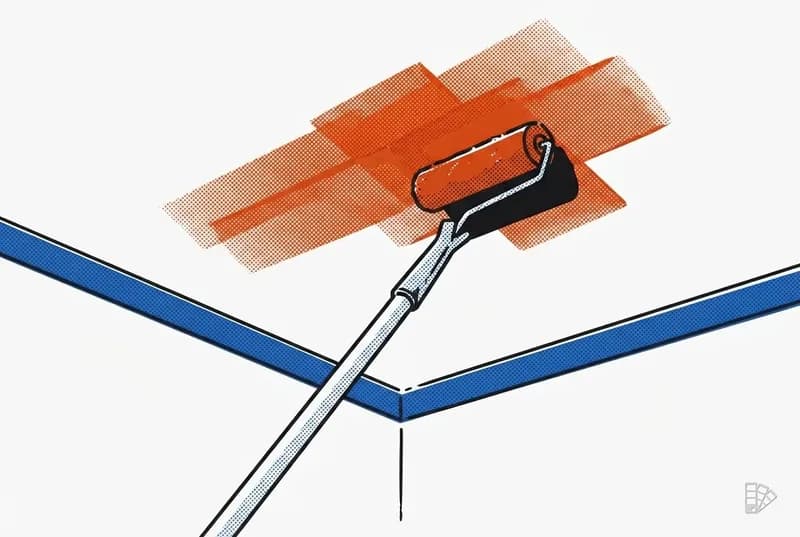
- Direction: Roll perpendicular to the primary light source (window). This minimizes visible roller marks once the paint dries and light rakes across it.
- Pattern: Start with a "W" or "M" shape to distribute paint, then smooth out with straight, overlapping passes in one direction. Never leave random "W" patterns visible.
- Loading: Roll the sleeve in the tray 3-4 times until saturated but not dripping. Roll slowly — fast rolling flings paint everywhere and creates an uneven coat.
- Pressure: Let the weight of the roller do the work. Pressing hard squeezes ridges of paint at the roller edges. Reload more often rather than pressing harder.
MAINTAIN THE WET EDGE
The wet edge is the unfinished border of your last roller pass. Each new pass must overlap into wet paint. If that edge dries before you reach it, you get a visible lap mark — a ridge where dry and wet paint overlap.
Work in 4 ft wide strips across the shortest dimension of the ceiling. Use our paint calculator to make sure you have enough paint to finish without stopping.
Second Coat & Drying
2-4 hr wait + 30-60 min
One coat is almost never enough for ceilings. The first coat seals the surface and reveals thin spots. The second coat delivers uniform coverage and the final color depth.
When is it dry enough?
RECOAT WINDOW
2-4 hrs
Touch-dry to the back of your hand. No tackiness. Low humidity speeds this up; high humidity can double it.
FULL CURE
30 days
Paint is fully hardened. Avoid scrubbing or hanging anything from the ceiling before then.
Second coat tips
- • Roll perpendicular to the first coat direction — this creates a crosshatch pattern that eliminates any directional lines.
- • Use the same cut-in-then-roll workflow. Don't skip cutting in edges on the second coat.
- • Check coverage under strong lighting by shining a flashlight at a low angle across the ceiling. Thin spots show as shadows.
If you're choosing between sheens for your ceiling, our paint sheen guide explains how flat hides imperfections while satin and semi-gloss add durability in wet areas.
Painting a Bathroom Ceiling
Bathroom ceilings take more abuse than any other ceiling in the house. Steam, condensation, and humidity create the perfect environment for mold, mildew, and peeling paint. Standard ceiling painting tips apply here, but you need different materials and a few extra steps.
Use mold-resistant paint
Standard flat ceiling paint will grow mildew within months in a bathroom. Use a paint with built-in mildewcide (e.g., Zinsser Perma-White, Benjamin Moore Aura Bath & Spa) or add a mildewcide additive to any latex paint.
Choose satin or semi-gloss
Flat paint absorbs moisture and stains. Satin or semi-gloss sheens repel water, resist mildew, and wipe clean easily. The slight sheen is barely noticeable on a ceiling but makes a huge difference in durability.
Fix ventilation first
No paint can overcome a bathroom with no exhaust fan. Install or repair the fan so it pulls at least 50 CFM (100 CFM for master baths). Run it during and 20 minutes after every shower.
For a deeper dive into moisture-resistant products, see our best paint for bathrooms guide. It covers wall and ceiling recommendations, brand comparisons, and sheen selection for wet areas.
Cathedral & Vaulted Ceilings
Vaulted and cathedral ceilings add dramatic height but create real challenges for painting. The peak can be 15-20 feet up, the surface is angled, and gravity pulls paint toward you faster than on a flat ceiling.
Equipment changes
| ITEM | FLAT CEILING | VAULTED CEILING |
|---|---|---|
| Extension pole | 4-6 ft | 8-12 ft telescoping |
| Ladder | 6 ft step | Extension or scaffold |
| Roller nap | 3/4" | 3/4" - 1" (more paint capacity) |
| Paint consistency | Standard | Slightly thicker or "no-drip" formula |
Technique adjustments
- • Work from the highest point (peak) downward. Drips run down the slope — you want to roll over them, not create them above finished areas.
- • Use a "no-drip" or "thick" ceiling paint formula. Regular paint sags on angled surfaces. Brands like Benjamin Moore Ultra Spec 500 and Sherwin-Williams ProMar make ceiling-specific paints designed for overhead work.
- • Take breaks. Overhead work at height is physically demanding. Fatigue leads to poor technique and safety risks.
SAFETY
If the peak is above 12 feet, seriously consider hiring a pro. Painting on extension ladders while looking up is one of the most common causes of DIY falls. Check our interior painting cost calculator to see what a contractor would charge — it may be worth the investment for safety alone.
5 Ceiling Painting Mistakes to Avoid
Using wall paint on the ceiling
Why it fails: Wall paints are thinner and formulated for vertical surfaces. On a ceiling, they drip more, show roller marks, and often have a slight sheen that highlights every imperfection under overhead lighting.
Fix: Buy paint labeled "ceiling paint" or "ceiling & wall flat." It's thicker, spatter-resistant, and dries to a dead-flat finish that hides flaws.
Rolling too fast
Why it fails: Speed causes the roller to fling tiny paint droplets everywhere — onto your face, glasses, floor, and walls. Fast rolling also creates uneven coverage with thin spots and heavy spots.
Fix: Roll at a slow, steady pace. If you hear a "sizzle" sound, you're going too fast. The roller should glide quietly.
Letting cut-in edges dry before rolling
Why it fails: The brushed border dries to a different texture than the rolled field. Where they overlap, you get a visible "picture frame" — a band of different sheen around the perimeter.
Fix: Cut in one 3-4 ft section at a time, then immediately roll that section before moving on. Work in manageable chunks.
Skipping primer on stains
Why it fails: Water stains, smoke damage, and marker bleed through latex paint — even after 3+ coats. The stain keeps migrating to the surface as the paint dries.
Fix: Spot-prime every stain with shellac-based primer (Zinsser B-I-N). It seals in one coat. Latex primer won't block tannin or water stains.
Pressing too hard with the roller
Why it fails: Excessive pressure squeezes paint to the edges of the roller sleeve, creating visible ridges ("tram lines") that dry into the finish. No amount of second-coating fixes them.
Fix: Use minimal pressure. If coverage is thin, reload the roller with more paint instead of pressing harder. Let the nap do the work.
Ceiling Painting Quick Reference
CEILING CHEAT SHEET
KEY NUMBERS
ROLLER NAP GUIDE
PAINTING ORDER
Always paint ceilings first. Drips on walls get covered in the next step. See our full room painting guide for the complete workflow.
BATHROOM CEILINGS
RELATED TOOLS & GUIDES
Best Paint for Ceilings
Flat ceiling paints, stain-blockers, and bathroom-ceiling picks.
GUIDEHow to Paint a Popcorn Ceiling
Roll or spray textured ceilings without the texture letting go.
GUIDEHow to Paint a Room
Full step-by-step room painting guide from prep to cleanup
FREE TOOLPaint Calculator
Find out exactly how much paint you need for any ceiling or room
GUIDEBest Paint for Bathrooms
Moisture-resistant picks for walls and ceilings in wet areas
GUIDEPopcorn Ceiling Removal Cost
What it costs to remove textured ceilings before repainting
COMPARISONFlat vs Eggshell
Compare the two most popular ceiling sheen options