Can You Paint Vinyl Siding?
Yes. The Vinyl Siding Institute and every major paint manufacturer treat vinyl as a paintable substrate, and both Sherwin-Williams and Benjamin Moore sell exterior lines specifically formulated for it. The question is never can it be painted — it is whether this siding, in this color, is worth painting. Two conditions decide it: the physical state of the panels and the color you want.
PAINT IT
- Panels are faded, oxidized, or just an outdated color, but still flat and firmly attached.
- Chalking is present (a white film rubs off on your hand) — that washes off.
- A handful of panels are cracked or loose and can be swapped from a leftover carton.
- Siding is out of warranty, or the manufacturer allows repainting in writing.
REPLACE IT INSTEAD
- Panels are brittle and snap when flexed — hairline cracks will telegraph through any coating.
- Siding is warped, buckled, or wavy already. Paint locks in the shape, it does not straighten it.
- Sheathing behind the siding is soft or wet. Fix the water first; paint traps nothing.
- You want a color darker than the current siding and are not using a vinyl-safe line.
THE 30-SECOND BRITTLENESS TEST
Unhook one panel at an inconspicuous corner with a zip tool and bend the bottom lip back on itself. Siding with life left flexes and springs back. Siding that crackles, whitens along the fold, or snaps is past the point where a $4,000 repaint makes sense — price a replacement instead and compare it against the exterior painting benchmarks.
One more consideration that catches homeowners: painting is not a repair for a moisture problem. Vinyl is a rainscreen — it is designed to let water drain behind it, and paint does not change that. If you have staining, soft trim, or interior moisture, that gets solved before a brush touches the wall. The same logic applies to painting brick and stone, where trapping moisture in the substrate causes most failures.
The Vinyl-Safe Color Rule (LRV 55)
THE ONE RULE THAT RUINS SIDING
Never paint vinyl siding a color darker than the color it is now. Dark pigment absorbs solar radiation instead of reflecting it. A panel painted in a deep color can run 20-50°F above ambient air temperature on a sunny wall, and vinyl begins to soften and deform around 160-165°F — a number that is easy to hit on a south-facing elevation in July. The siding does not fail immediately. It ripples, waves between the nail hem and the butt edge, and pulls at the corners over one or two summers.
LIGHT REFLECTANCE VALUE SCALE
LRV runs 0 (absorbs everything, black) to 100 (reflects everything, pure white). Every paint fan deck prints it on the back of the chip or in the online color detail. LRV 55 is the working floor for standard exterior paint on vinyl; below that you need a heat-reflective vinyl-safe formula, and below 40 you are gambling with the panels no matter whose can it came from.
LRV SAFETY CHECK
Tap a color family to see whether it clears the vinyl-safe threshold. LRV values are typical for the family, not a specific product.
SAFE ON ANY EXTERIOR ACRYLIC
LRV 55 or higher reflects enough sunlight that panel temperature stays near the range the siding was extruded for. Any quality 100% acrylic exterior paint will do — no special formula required.
Manufacturer Vinyl-Safe Palettes
Vinyl-safe colors are not just light colors. They use pigments that reflect infrared light while still looking dark to the eye, which is how a mid-tone gray or muted blue can hold a lower LRV without cooking the panel. The catch: the color only stays vinyl-safe when it is tinted into an approved product line. Ask for the color by its vinyl-safe designation at the counter, not just by name.
SHERWIN-WILLIAMS VINYLSAFE
Roughly 100 colors, including a limited set of deeper shades, cleared for use over vinyl when applied in Emerald, Duration, Resilience, SuperPaint, or Latitude exterior.
BENJAMIN MOORE VINYL-APPROVED
No single branded collection — BM publishes vinyl-appropriate colors within Regal Select and Aura Exterior, where Color Lock pigment technology extends how deep you can safely go.
BEHR / VALSPAR EXTERIORS
Big-box lines carry no formal vinyl-safe program. Stay at LRV 55+ and no darker than the original panel color, and confirm the tint base on the can lid.
WARRANTY WATCH-OUT
Most vinyl siding carries a limited lifetime warranty against excessive fading and manufacturing defects. Heat distortion caused by a coating is a homeowner-applied change, and manufacturers routinely deny those claims — some void the warranty on any painted panel. If the siding is still under warranty, read the exclusions before you buy paint, and keep the color documentation showing the LRV you used.
“THE PAINT ALMOST NEVER FAILS FIRST. THE PANEL MOVES, AND THE PAINT JUST SHOWS YOU WHERE.”
Standard field experience on dark-tinted vinyl repaints
If your heart is set on a deep charcoal or black exterior, the honest answer is to price replacement panels manufactured in that color — they are extruded with heat-stabilized resin and backed by the maker. Run both numbers in the exterior painting cost calculator before committing to a color you cannot safely paint.
Best Paint for Vinyl Siding
Vinyl moves. A 12-foot panel can grow and shrink up to half an inch between a January morning and an August afternoon, which is exactly why the panels hang loose on their nails. Your coating has to stretch with that. That rules out anything rigid and leaves two chemistries: 100% acrylic latex, and urethane-modified acrylic.
WHAT WORKS ON VINYL — AND WHAT DOESN’T
100% acrylic latex
Flexes with the panel through a 100°F seasonal swing.
Urethane-modified acrylic
Same flex, harder surface, better against chalk and dirt.
Vinyl-safe tinted base
Infrared-reflective pigment keeps panel temperature down.
Oil-based / alkyd
Cures rigid and brittle — cracks the first time the wall moves.
Elastomeric coating
Too thick, bridges the drainage laps, traps moisture behind panels.
Interior or budget flat exterior
No UV package or flex additives; chalks out in two seasons.
Product Picks (2026 Ranges)
Retail prices swing by region, sale cycle, and contractor account pricing. Treat these as typical shelf ranges as of 2026, not quotes.
SW DURATION EXTERIOR
100% acrylic, VinylSafe tintable
$60-75/gal
The contractor default on vinyl. Thick build, self-priming on sound siding.
SW EMERALD EXTERIOR
Urethane-modified acrylic
$75-95/gal
Best flexibility and dirt resistance. Worth it on south and west elevations.
BM REGAL SELECT EXTERIOR
100% acrylic
$55-70/gal
Solid mid-tier. Stick to lighter vinyl-appropriate colors in this line.
BM AURA EXTERIOR
Acrylic with Color Lock
$80-100/gal
Deepest color retention available; the pigment tech is why deeper tones survive.
HOW MUCH TO BUY
Smooth vinyl covers at roughly 350-400 sq ft per gallon per coat; woodgrain-embossed panels drop that to 300-350. A 2,000 sq ft two-story with about 1,800 sq ft of wall area runs 10-12 gallons for two coats. Run your own wall area through the paint calculator and add 10% if you are spraying — overspray and hose priming eat more than most people budget for.
Do You Need Primer on Vinyl Siding?
Usually no. A quality 100% acrylic exterior paint bonds directly to clean, sound vinyl, and every extra film you add is another layer that can fail. Priming a whole house you did not need to prime adds roughly $0.40-$0.75 per sq ft in material and labor for nothing.
PRIME ONLY WHEN
- Chalking is still coming off on a dry hand after washing — a bonding primer locks down the residue the wash could not.
- The surface is pitted, hail-dimpled, or heavily oxidized to a dull, porous feel.
- You are covering bare repair patches, replaced panels, or exposed trim where the substrate changes.
- The siding was painted before and the old film is failing — spot-prime after scraping.
Use a water-based bonding primer rated for PVC and plastics. Never an oil-based primer — it cures rigid and cracks with the first big temperature swing.
How to Paint Vinyl Siding: 7 Steps
A crew of two paints an average single-story ranch in two to three days: most of day one is washing, most of day two is coating. The wash is not the boring part you rush — it is the step that decides whether the paint is still there in year eight.
Inspect and flex-test the panels
30-60 min
Walk all four elevations. Flag cracked, loose, or wavy panels, note any soft trim, and flex a bottom lip to confirm the vinyl is still pliable. Rub a dry hand along a sunny wall — the white film that comes off is chalk, and how much there is sets how hard you wash.
Wash off chalk, mildew, and pollen
4-6 hrs
- Mix a siding cleaner or a TSP substitute at label strength — roughly 1/2 cup TSP per gallon of warm water. For mildew, add 1 part household bleach to 3 parts water and keep it off plantings.
- Work bottom to top in 10-foot sections with a soft-bristle brush on a pole, then rinse top to bottom so you never leave a dirty run line.
- If you pressure wash, stay at 1,300-1,500 PSI with a 40-degree tip, keep the wand level or angled slightly down, and never spray up under the laps — water driven behind the siding takes days to dry and will blister the coating.
- Let the wall dry a full 24 hours before any paint. Vinyl feels dry long before the cavity behind the laps is.
Repair, re-secure, and caulk
1-3 hrs
Replace cracked panels with a zip tool before painting — matching a color after two coats is impossible. Re-nail loose courses, leaving the nail head about 1/32 inch proud so the panel can still slide. Caulk where siding meets trim, corner posts, and penetrations with a paintable elastomeric caulk. Do not caulk the horizontal laps or the weep holes: those are drainage, not gaps.
Mask, protect, and stage
1-2 hrs
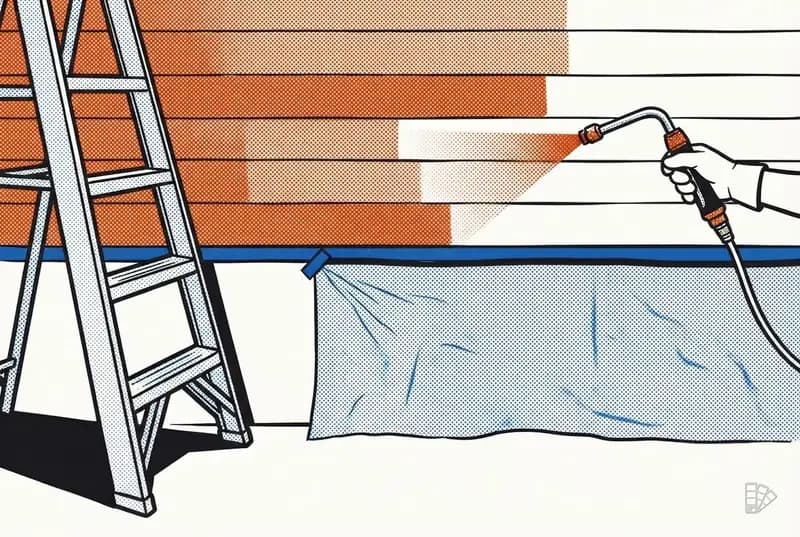
- Cover windows, doors, light fixtures, meters, and vents with plastic and 2-inch tape. Overspray on glass costs more time to scrape than masking costs to install.
- Tarp shrubs and beds; drop cloth the walkways. Vinyl-safe colors are light, and light overspray shows on dark mulch and driveways.
- Set ladders or staging so you can reach a full panel run without a break mid-wall.
Confirm the weather window
Check twice
Apply between 50°F and 85°F air and surface temperature, with the surface at least 5°F above the dew point and no rain for 24 hours. Chase the shade around the house — a sun-heated panel flashes the film before it can level, which shows up as lap marks and poor adhesion. The full temperature and dew point rules matter more on vinyl than on any other siding, because the panel itself heats faster than wood or fiber cement.
First coat: spray and back-roll (or roll)
4-8 hrs
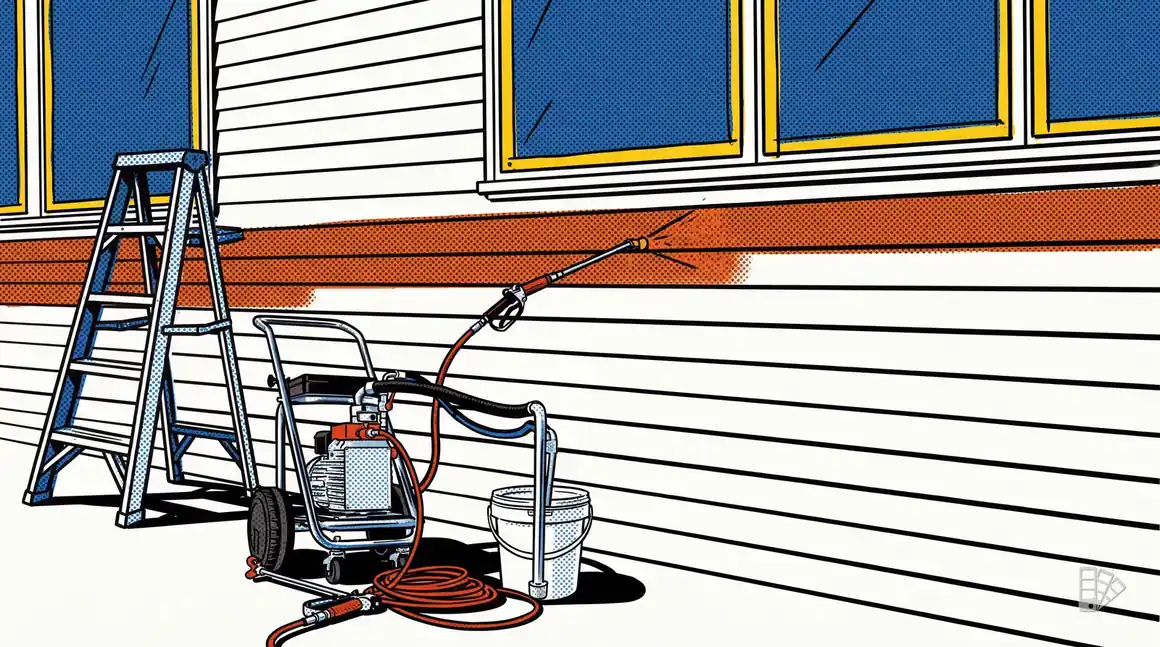
Spraying with a back-roll is the production method: an airless with a 0.015-0.017 tip lays the film, and a 3/8-inch nap roller immediately works it into the woodgrain texture and under the lap shadows. One person sprays, one rolls, and neither gets ahead of the other by more than a panel run.
- Brush the underside of each lap first — that shadow line is where thin coverage always shows up later.
- Keep a wet edge across the full length of a course. Stopping mid-wall on siding leaves a visible band.
- Two thin coats beat one heavy coat every time. Heavy film on vinyl is more likely to crack when the panel moves.
Rolling and brushing alone is fine on a single-story house — it just costs about three times the labor hours. See sprayer setup and technique for tip sizing and pressure, or compare the two methods head-to-head in spray vs roll painting.
Second coat and walk-around
4-8 hrs
Recoat after the label window — typically 4 hours at 77°F, longer when it is cool or humid. Then walk each elevation with the sun low and look across the wall, not at it: raking light reveals holidays under the laps and thin spots at the corner posts. Touch those in with a brush while the ladders are still up.
DON’T PAINT THESE
Leave the weep holes at the bottom of each panel open, skip the J-channel drainage slots, and keep paint out of the nail hem slots so panels can still float. Sealing any of the three turns a drainage system into a moisture trap.
TAKEAWAY
Budget 60% of your hours to washing, repair, and masking, and 40% to coating. Crews that flip that ratio are the reason painted vinyl has a reputation problem.
How Long Painted Vinyl Siding Lasts
A properly prepped repaint with a premium 100% acrylic holds 8-10 years on average. Contractor-grade paint over a quick rinse gets you 5 years, sometimes 3. Factory-finished vinyl, for reference, keeps acceptable color for 20-30 years before fading — painting is always a shorter cycle than the original finish, and that is the trade you are making for the color change.
EXPECTED REPAINT LIFE BY EXPOSURE
Typical ranges for a two-coat premium acrylic. South and west walls take the UV and heat load, so they age first — plan on refreshing those elevations a cycle ahead of the rest of the house.
Why Vinyl Siding Paint Peels
Peeling on vinyl is a prep or product diagnosis, almost never bad luck. Match the pattern you are seeing to the cause before you spend a weekend scraping.
Chalk left on the surface
Paint peels in wide sheets, often with a powdery back side
Color too dark for the panel
Waving and buckling first, cracking through the film second
Oil-based primer or paint
Hairline cracking along every lap within two seasons
Coated below 50°F or near dew point
Chalky, poorly-coalesced film that wipes off under a rag
Repairing a failed coat means scraping every loose edge, sanding the margins feathered, washing again, and spot-priming with a bonding primer before recoating — the same sequence covered in how to fix peeling paint. If more than about a third of a wall is failing, recoat the whole elevation. Spot repairs on siding never blend.
MAINTENANCE THAT BUYS YEARS
Rinse the siding once a year with a garden hose and a soft brush, keep sprinklers off the walls, and trim shrubs back 12 inches so the surface dries. Mildew feeding on dirt is the most common reason a five-year-old paint job looks ten.
Cost to Paint vs Replace Vinyl Siding
Painting wins on upfront cost by a wide margin. Replacement wins on the 20-year number if the siding is close to end of life anyway. Here is the comparison on a typical 2,000 sq ft two-story with roughly 1,800 sq ft of wall area, at 2026 pricing.
METRIC
PAINT IT
REPLACE IT
THE 20-YEAR MATH
Two paint cycles over 20 years land in the same neighborhood as one replacement. If the panels are sound and you plan to sell inside a decade, paint is clearly the better spend. If the siding is 25+ years old, brittle, or you want a dark exterior, the second paint cycle is money you would rather have put toward new panels. Price the paint side precisely with the exterior painting cost calculator and sanity-check it against the regional cost-to-paint-a-house ranges.
Painting Vinyl Siding: Pros and Cons
PROS
- A third to half the cost of replacement for the same visual change.
- Done in a long weekend instead of two weeks of tear-off.
- No landfill load — the existing panels stay on the wall.
- Fixes oxidation and fade that cleaning alone cannot.
CONS
- Color choice is capped by the LRV rule; dark exteriors are off the table.
- Adds a maintenance cycle every 8-10 years that factory vinyl did not have.
- Can void a siding warranty that is still in force.
- Does nothing for damaged panels, dated profiles, or missing insulation.
Vinyl Siding Painting FAQ
Quick Reference Cheat Sheet
VINYL SIDING PAINT CHEAT SHEET
GO / NO-GO BEFORE YOU BUY PAINT
KEY NUMBERS
PRODUCT SHORTLIST (2026 RANGES)
SW Duration Exterior
VinylSafe tint · $60-75/gal
SW Emerald Exterior
Urethane acrylic · $75-95/gal
BM Regal Select Ext.
100% acrylic · $55-70/gal
BM Aura Exterior
Color Lock · $80-100/gal
NEVER DO THIS
Oil-based primer or paint
Cures rigid, cracks at every lap
Caulking laps or weep holes
Traps water behind the panels
Spraying up under the courses
Drives water into the wall cavity
One heavy coat to save time
Film cracks when the panel moves
Price the job before you start with the exterior painting cost calculator, then size the order with the paint calculator.
RELATED TOOLS & GUIDES
Exterior Painting Cost Calculator
Price a vinyl siding repaint by wall square footage, stories, and prep level.
COMPARISONSpray vs Roll Painting
Which application method wins on siding — production rates and finish quality.
GUIDEPainting in Cold Weather
Temperature and dew point windows that decide whether siding paint cures or fails.
GUIDEHow to Fix Peeling Paint
What to do when a previous vinyl paint job starts flaking off in sheets.
GUIDECost to Paint a House
Full exterior pricing benchmarks by siding type, square footage, and region.