HOW TO USE A PAINT SPRAYER
March 9, 2026 · 14 min read
Than rolling
150+ sq ft per minute
Full room (walls + ceiling)
vs 6-8 hrs with a roller
Factory-like finish
No roller stipple or brush marks
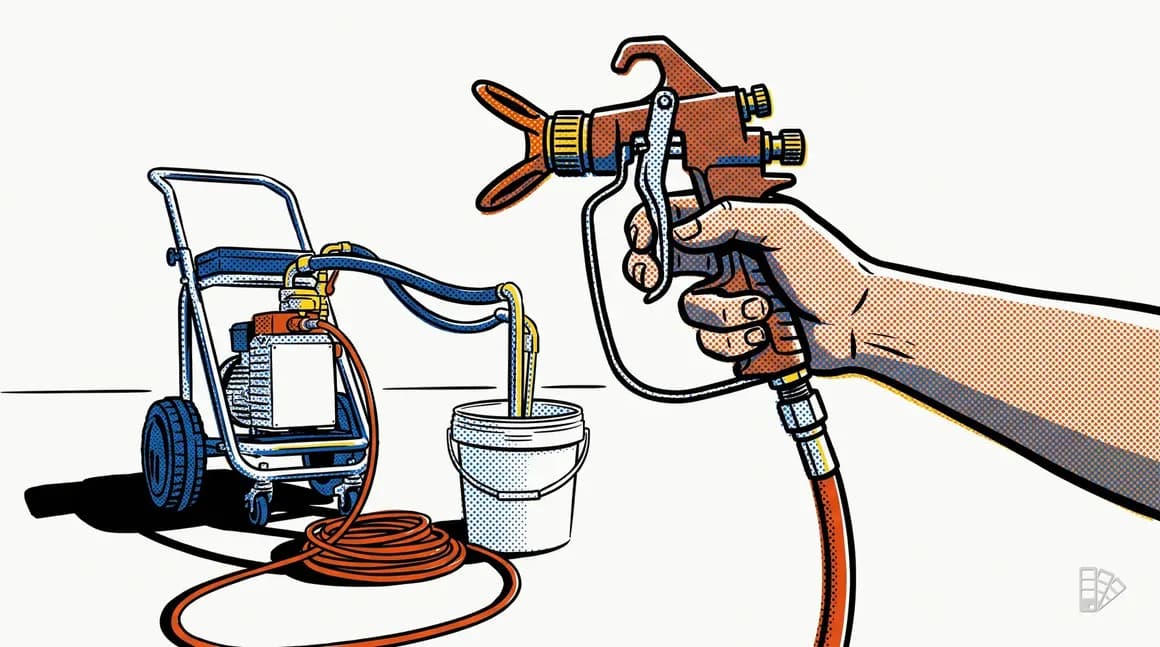
A paint sprayer covers a wall in minutes instead of the 45–90 minutes it takes with a roller. Professional painters use sprayers on 80%+ of jobs because the finish quality is smoother, the coverage is more even, and the time savings are massive. But a sprayer used wrong creates overspray disasters, orange-peel texture, and runs that take longer to fix than rolling would have. This guide covers everything from choosing the right sprayer to dialing in your technique so your results look like a professionally painted room.
Airless vs HVLP vs Compressed Air
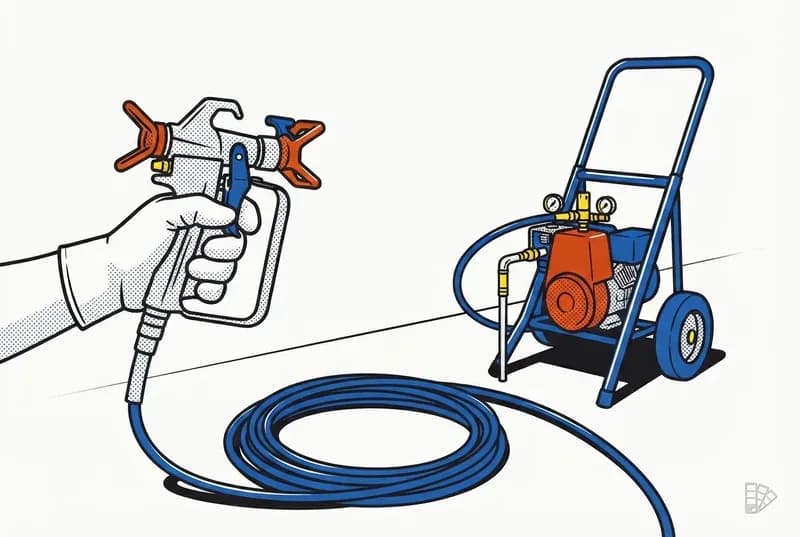
Choosing the wrong sprayer type is the #1 reason first-timers get bad results. Each type atomizes paint differently, and that determines your speed, finish quality, and overspray level.
AIRLESS
$200-6001,500-3,000 PSI · Best for: Walls, ceilings, exteriors, fences
Pros
- + Fastest coverage
- + Handles thick paint unthinned
- + Best for large areas
Cons
- − More overspray
- − Heavier cleanup
- − Harder to control for detail
HVLP
$80-3502-10 PSI · Best for: Cabinets, trim, furniture, doors
Pros
- + Minimal overspray
- + Smooth fine finish
- + Easy pressure control
Cons
- − Slower on large areas
- − Paint must be thinned
- − Small cup capacity
COMPRESSED AIR
$30-150 + compressor20-50 PSI · Best for: Touch-ups, crafts, auto body
Pros
- + Very fine atomization
- + Cheapest entry point
- + Available at any store
Cons
- − Slowest method
- − Highest overspray
- − Requires compressor
PRO RECOMMENDATION
For painting rooms and house exteriors, go airless. For kitchen cabinets, doors, and trim, use HVLP. Most pros own both.
Setup & Preparation
Masking takes 2–3x longer than the actual spraying. Skip it, and you spend even longer cleaning overspray off surfaces you didn’t protect. Budget at least 60–90 minutes per room for masking.
MASKING CHECKLIST
- Floors — 1-mil plastic sheeting or rosin paper
- Trim, baseboards, window frames — painter's tape + 12" masking paper
- Ceiling line — tape off if spraying walls only
- Outlets, switches, light fixtures — tape and plastic bag
- Furniture — remove from room or cover completely with plastic
- HVAC vents — tape closed to prevent paint entering ductwork
Priming & Flushing
Every sprayer must be primed before use to purge air from the lines. Skipping this step causes sputtering, uneven spray, and wasted paint.
- 1
Fill & prime
Place the suction tube in your paint bucket. Set the valve to PRIME. Turn on the sprayer and let paint flow into a waste bucket until the stream is solid — no bubbles or water.
- 2
Test on cardboard
Switch the valve to SPRAY. Point the gun at scrap cardboard and pull the trigger. Adjust pressure until you get even coverage with no tails or heavy spots.
- 3
Check for leaks
Inspect every hose connection and the gun tip for drips. A small leak under pressure becomes a big mess fast. Tighten fittings and replace worn gaskets.
Spray Tip Sizes
The tip determines fan width and material flow. Use our paint calculator to estimate how much paint you need for your tip’s flow rate.
AIRLESS TIP SIZE GUIDE
First digit doubled = fan width in inches. Last two digits = orifice size in thousandths. A 515 tip sprays a 10" fan with a .015" orifice.
Spraying Technique (Step-by-Step)
Good spraying technique is simple once you understand three rules: keep the gun parallel, maintain distance, and overlap each pass by 50%.
PROPER SPRAY MOTION
The five-point technique
- Hold the gun 10–12 inches from the surface. Too close causes runs. Too far wastes paint as overspray and creates orange-peel texture.
- Keep the gun perpendicular at all times. Never arc or fan the gun — angling it produces heavy edges and thin centers. Move your whole arm, not your wrist.
- Start moving before you pull the trigger. This prevents a heavy blob at the start of each pass. Release the trigger before you stop moving.
- Overlap each pass by 50%. Aim the gun so each new stroke covers the bottom half of the previous one. This gives you two thin coats in one pass for even coverage.
- Maintain a consistent speed. Moving too slowly creates runs. Too fast leaves thin spots. A steady 3–4 feet per second is ideal for most airless sprayers.
“TWO THIN COATS ALWAYS BEAT ONE THICK COAT. THE SPRAYER MAKES THIS EASY — EACH 50% OVERLAP IS ALREADY BUILDING YOUR SECOND PASS.”
Interior Spraying Tips
Interior spraying requires more masking and lower pressure than exterior work, but the results are worth it. A sprayed room has zero roller stipple, seamless coverage, and a finish that looks like factory-applied paint.
BEST PAINT SPRAYER FOR INTERIOR WALLS
For most interior wall jobs, an airless sprayer with a 515 tip at 1,200–1,500 PSI is ideal. This gives you a 10-inch fan pattern wide enough to cover quickly without excessive overspray in confined spaces.
Room-by-room approach
Walls
Eggshell or satinSpray top to bottom in vertical strokes. Work one wall at a time. Keep a wet edge — don't let one wall dry before starting adjacent walls.
Ceilings
Flat or matteUse a 517 tip and lower pressure to reduce bounce-back. Spray in long parallel passes along the shorter dimension. Always spray the ceiling before the walls.
Cabinets & trim
Semi-gloss or satinSwitch to an HVLP sprayer or use a fine finish airless tip (311-413). Apply 3 thin coats with light sanding between coats for a glass-smooth finish.
For sheen selection, see our satin vs semi-gloss comparison and eggshell vs satin guide.
Ventilation is critical
Open all windows and run a box fan exhausting air out. Wear a P100 respirator — not a dust mask. Airless sprayers atomize paint into particles small enough to reach your lungs. Never spray in a closed room.
Back-rolling after spraying
Many pros spray a section, then immediately roll over it with a lightly-loaded roller. This pushes paint into the wall texture, eliminates any thin spots, and gives the best of both worlds: sprayer speed with roller adhesion. Essential on textured walls and new drywall.
How to Spray Paint a House Exterior
Exterior spraying is where the speed advantage of a paint sprayer really shines. A typical 2,000 sq ft home exterior takes 2–3 days with a roller but can be sprayed in 4–6 hours of actual spray time (masking adds another half day). Check our cost to paint a house guide for full pricing breakdowns.
Exterior spray order
SPRAY ORDER (TOP TO BOTTOM)
Soffits & fascia
Use a 413 tip, spray parallel to boards
Siding — body color
517 or 619 tip, horizontal passes following lap direction
Trim & window frames
Switch to 413 tip, shield glass with cardboard
Doors & shutters
Remove hardware, spray flat on sawhorses if possible
Foundation / water table
413 tip, watch for bounce-back off concrete
Weather conditions
Temperature
50-90°FPaint film won't form properly below 50°F. Above 90°F, it dries too fast and flashes.
Humidity
< 60%High humidity slows drying and causes blistering. Check morning dew — wait until surfaces are completely dry.
Wind
< 10 mphWind carries overspray onto cars, landscaping, and neighbors. Spraying in wind above 10 mph is a liability issue.
Direct sun
AvoidFollow the shade around the house. Sun-heated siding causes flash drying, poor adhesion, and visible lap marks.
For cold-weather strategies, see our painting in cold weather guide.
7 Mistakes That Cause Runs & Orange Peel
Spraying too close to the surface
Why it fails: Paint pools and runs immediately. At 6 inches, you get 3x the material deposit compared to 12 inches, creating sags that are visible through the final coat.
Fix: Hold the gun 10-12 inches away. Use a ruler or your hand span to calibrate the distance before you start.
Arcing the gun instead of keeping it parallel
Why it fails: Swinging the gun in an arc means the center of each pass gets heavy coverage while the edges get thin. You end up with visible stripes.
Fix: Move your entire arm parallel to the wall. Lock your wrist. Think of your arm as a pendulum, not a wiper blade.
Not overlapping passes by 50%
Why it fails: Each single pass alone is too thin. Without overlap, you get streaky, transparent coverage that requires extra coats and extra paint.
Fix: Aim the gun so each new stroke hits the midpoint of the previous pass. Two thin layers build up to perfect coverage.
Skipping the test spray on cardboard
Why it fails: Pressure too high = runs and overspray. Too low = spitting and orange peel. You won't know until you see the pattern on a test surface.
Fix: Always test on cardboard or scrap before touching the wall. Adjust pressure until the pattern is even with no tails on the edges.
Inadequate masking
Why it fails: Airless overspray travels 6-10 feet and settles on every unprotected surface. Cleaning dried overspray off trim, glass, and floors takes hours.
Fix: Mask everything you're not painting. Use 12-inch masking paper on trim, plastic on floors, and tape on every edge.
Letting the sprayer sit with paint in it
Why it fails: Paint dries inside the pump, lines, and gun within 30-60 minutes of stopping. Dried paint in the check valves requires disassembly to fix.
Fix: If you stop for more than 15 minutes, trigger the gun into a waste bucket every 10 minutes. Clean immediately when done for the day.
Using the wrong tip size
Why it fails: Too small a tip clogs with latex paint. Too large wastes paint and creates heavy, saggy coverage. The wrong tip makes even perfect technique look bad.
Fix: Match tip to material: 515 for interior walls, 413 for trim, 517 for exterior. When in doubt, go one size smaller.
Quick Reference Cheat Sheet
PAINT SPRAYER CHEAT SHEET
SETUP CHECKLIST
KEY NUMBERS
SPRAYER VS ROLLER
Use a sprayer when
- • Large area (full room or exterior)
- • Empty/maskable space
- • Smooth finish is critical
- • Multiple coats needed
Use a roller when
- • Small area or single accent wall
- • Furnished rooms (too much masking)
- • Heavily textured surfaces
- • Quick touch-ups
CLEANUP (DO NOT SKIP)
- 1. Run clean water through the sprayer until it runs clear
- 2. Remove the tip and guard — soak in warm water
- 3. Scrub the filter screen with the included brush
- 4. Wipe down the gun body and hose connections
Skipping cleanup is how you ruin a $400 sprayer. Budget 20-30 minutes after every use.
Calculate how much paint you need with our paint calculator · Get a cost estimate with the interior painting cost calculator
RELATED TOOLS & GUIDES
Spray vs Roll Painting
Production rates, paint usage, and when to back-roll.
FREE TOOLPaint Calculator
Figure out exactly how many gallons you need before loading the sprayer
GUIDEHow to Paint a Ceiling
Ceiling-specific technique for drip-free results with roller or sprayer
GUIDEHow to Paint Kitchen Cabinets
Step-by-step cabinet painting guide — sprayer technique included
COMPARISONSatin vs Semi-Gloss
Which sheen works best for sprayed walls, trim, and cabinets?
GUIDECost to Paint a House
Full pricing breakdown for DIY and pro painting projects