HOW TO PAINT A DOOR
March 9, 2026 · 10 min read
Per door
Includes drying between coats
Paint needed
Covers 2 doors, both sides
For full coverage
Sand lightly between coats
Doors are the most looked-at surfaces in your home — you stand face-to-face with one every time you enter a room. A sloppy door paint job is impossible to hide, but a clean one makes the entire space feel professionally finished. Whether you're repainting a single interior door or tackling every door in the house, this guide covers the right order for panel and flat doors, the on-hinges vs. off-hinges decision, prep, priming, and painting door frames.
On-Hinges vs. Off-Hinges Method
The biggest decision before you start: do you remove the door or paint it in place? Both approaches work, but the right choice depends on how many doors you're doing and what finish quality you need.
ON-HINGES
Paint the door while it's hanging in the frame
BEST FOR
1-2 doors, touch-ups, or when you can't remove the door (painted-shut hinges, old screws)
OFF-HINGES
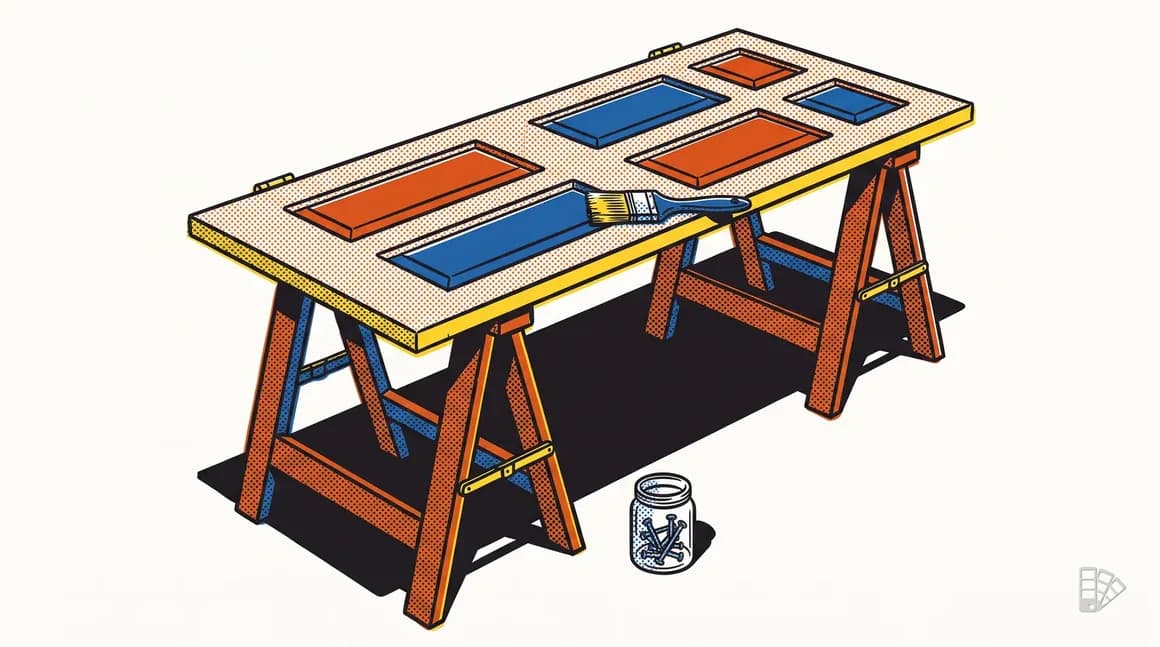
Remove the door and paint on sawhorses or a flat surface
BEST FOR
3+ doors at once, full room repaints, or when using a paint sprayer for a factory-smooth finish
PRO TIP
If you remove the door, drive a long screw into the top edge to use as a handle for lifting. Mark each hinge position with painter's tape labeled “top” and “bottom” so they go back in the right spots. Place the door across two sawhorses with the handle side down.
Prep the Door
30-45 min
Prep is where the finish is won or lost. A paint job that starts peeling after six months was almost always a prep failure, not a paint failure.
Remove hardware
- Take off the doorknob, latch plate, deadbolt, and any kick plates. Drop screws into labeled bags so they go back on the right door.
- If painting on-hinges, tape off hinges with painter's tape. Press the edge firmly with a plastic putty knife for a crisp seal.
Clean and sand
Wipe the door with a damp rag and TSP substitute to remove grease and grime. Once dry, sand the entire surface with 150-grit paper to scuff the existing finish. Switch to 220-grit for a smooth final pass. Vacuum or tack-cloth all sanding dust before priming.
Fill and repair
Fill dents, screw holes, and peeling spots with lightweight spackle. Let it dry 20 minutes, then sand flush with 220-grit. Run your palm across the repair — if you feel the edge, sand more. Paint magnifies every bump.
Prime
Apply a bonding primer if the door is bare wood, stained, or switching from oil-based to latex. For previously painted doors in good condition with the same paint type, you can skip primer and go straight to two coats of semi-gloss or satin finish.
LEAD PAINT WARNING
Homes built before 1978 may have lead paint on doors. Do not sand without testing first. See our lead paint certification guide for EPA requirements.
Panel Door Paint Order
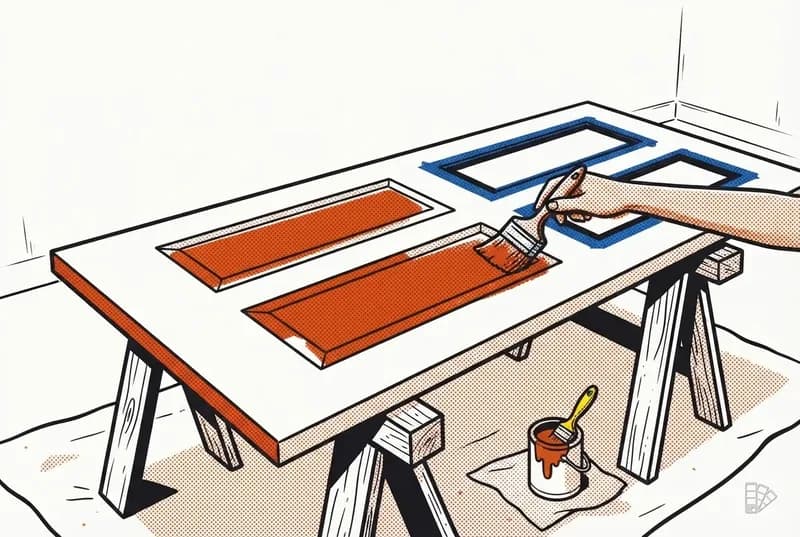
Painting a panel door in the wrong order causes drips in the recesses and visible lap marks on the stiles. Follow this sequence to maintain a wet edge and avoid rework.
6-PANEL DOOR — PAINT ORDER
Panels first
Start with all recessed panels. Use a 2-inch angled brush and work paint into the moulding edges. Wipe any drips immediately before they set.
Stiles (vertical)
Paint the vertical strips: left side, center mullion, right side. Brush in long, continuous strokes from top to bottom.
Rails (horizontal)
Finish with the horizontal rails: top, lock rail, any mid-rails, then bottom. Blend where stiles and rails meet while the paint is still wet.
Painting Flat (Flush) Doors
20-30 min per coat
Flat doors are simpler than panel doors, but they expose every roller mark. The key is using the right roller and maintaining a wet edge across the full surface.
FLAT DOOR TECHNIQUE
- 01Use a 4-inch high-density foam mini roller for a smooth, stipple-free finish. Avoid cheap fuzzy rollers — they leave orange-peel texture on doors.
- 02Load the roller with paint and start at the top-left corner. Roll in long, continuous strokes from top to bottom, slightly overlapping each pass.
- 03Work quickly across the width of the door. You must reach the opposite edge before the first strip starts to tack up (usually 5-10 minutes in warm conditions).
- 04Once the full face is covered, do a final lay-off pass: lightly roll from top to bottom in one direction with barely any pressure. This evens out roller marks.
- 05Brush the edges with a 2-inch angled brush. If painting with a sprayer, you can skip the roller entirely and get a factory-smooth finish.
PAINT CHOICE MATTERS
Use a self-leveling acrylic-alkyd hybrid (like Benjamin Moore Advance or Sherwin-Williams Emerald Urethane) for the smoothest brush and roller finish on doors. These flow out roller marks and cure to a hard, scrubbable semi-gloss or satin shell.
Interior vs. Exterior Doors
The process is similar, but exterior doors take more abuse from weather, UV, and foot traffic. Here's what changes.
| FACTOR | INTERIOR | EXTERIOR |
|---|---|---|
| Paint type | Acrylic-alkyd hybrid or latex | 100% acrylic exterior paint |
| Sheen | Satin or semi-gloss | Semi-gloss or gloss |
| Primer | Optional if existing paint is sound | Always — blocks tannin bleed and UV |
| Coats | 2 coats | 2-3 coats (more UV protection) |
| Prep | Sand, clean, fill holes | Sand, scrape, caulk gaps, fill rot |
| Weather | Paint anytime | 50-85°F, <60% humidity, no rain 24 hrs |
| Dry time | 1-2 hrs between coats | 4-6 hrs (thicker film) |
| Cure time | 30 days | 30 days — avoid slamming |
EXTERIOR DOOR TIP
Paint the exterior side of the door in the shade, or wait until the sun moves off it. Direct sunlight heats the surface above 90°F and causes the paint to dry too fast, leaving brush marks and poor adhesion. For weather timing, see our painting in cold weather guide.
How to Paint Door Frames & Casings
Painting door frames at the same time as the door gives you a cohesive finished look. The technique is similar to painting trim and baseboards, but with a few door-specific considerations.
DOOR FRAME PAINTING STEPS
- 01Remove the door (or open it fully and wedge it). You need clear access to the entire jamb including the hinge mortises and strike plate recess.
- 02Scrape and sand the frame with 150-grit paper. Door frames take more abuse than baseboards — look for paint buildup in corners and dings along the strike-side jamb.
- 03Caulk the wall-to-casing seam with paintable latex caulk. This gap often opens up as the house settles and it's the most visible flaw from a distance.
- 04Paint the casing first (the decorative trim around the frame). Use a 2-inch angled brush and work from the outer edge inward so any drips fall on unpainted frame, not the wall.
- 05Paint the jamb (the inside channel where the door sits). Start at the top, work down each side. Use semi-gloss for durability — the jamb gets scuffed by the door every time it closes.
- 06Paint the head (top of the frame) last. Cut in carefully where it meets the wall, then brush out to the edge.
Door frame tips
- Match the sheen — frame and door should be the same sheen level. Mixing satin doors with gloss frames looks odd.
- Don't forget the top edge of the door frame. It collects dust and is visible from stairs or lofts.
- Color rule: door frames almost always match the door, not the wall. If you're painting the door a bold color, keep frames white or off-white so it doesn't overwhelm.
Drying Times & Second Coat
Doors are high-touch surfaces — handles, latches, kicks. If you close a door before it's cured, the paint will stick to the frame and peel off in sheets. Patience here saves you from repainting.
Dry to touch
Don't test with your finger — hover your hand 1 inch above. If you feel warmth, it's not ready.
Recoat window
Sand lightly with 220-grit between coats for best adhesion. Remove dust with a tack cloth.
Full cure
Avoid slamming, heavy use, or cleaning the door for a full month. The paint hardens over time.
DO YOU NEED A SECOND COAT?
Almost always yes. Doors get more scrutiny than walls because people stand directly in front of them. Even if the first coat looks solid, the second coat fills micro-pinholes and evens out sheen. For dark colors (navy, black, deep red), plan on three coats to prevent the primer or old color from ghosting through.
DO NOT CLOSE THE DOOR
Freshly painted doors stick to frames — even when they feel dry. Keep the door propped open 2-3 inches with a wedge for at least 24 hours after the final coat. In humid conditions, wait 48 hours.
Quick Reference Cheat Sheet
DOOR PAINTING CHEAT SHEET
PANEL DOOR ORDER
SUPPLIES
KEY NUMBERS
RECOMMENDED SHEEN
Interior doors
Satin / Semi-gloss
Exterior doors
Semi-gloss / Gloss
Door frames
Match the door
See satin vs semi-gloss for a full breakdown, or our paint calculator to estimate how much you need.
RELATED TOOLS & GUIDES
Best Paint for Trim
Enamel trim paints ranked by hardness, leveling, and sheen.
GUIDEHow to Paint Trim & Baseboards
Complete guide to painting trim with crisp, clean lines
GUIDEHow to Paint a Room
Full room painting guide from prep to cleanup
COMPARISONSatin vs Semi-Gloss
Which sheen is best for doors, trim, and walls?
FREE TOOLPaint Calculator
Find out exactly how much paint you need
GUIDEHow to Paint Kitchen Cabinets
Step-by-step cabinet painting with pro-level results