CABINET REFINISHING VS PAINTING
Two words the trade uses precisely and homeowners use interchangeably — and a third, refacing, that keeps sneaking into the same quote. Here is what each one actually does to your cabinets, what it costs, and which one your doors will even accept.
Three Words, Three Jobs
Half the confusion in a cabinet quote comes from vocabulary. A homeowner asks for a “refinish” and means paint. A salesperson quotes a “refinish” and delivers refacing at triple the price. In the trade the three words mean three specific, non-overlapping things, and the difference decides both your budget and whether the job is even possible on your doors.
REFINISHING
Strip or sand the old clear coat off, re-stain the bare wood, then lay down fresh lacquer, conversion varnish, or polyurethane.
- Keeps
- Your doors, drawer fronts, boxes, and the wood grain
- Needs
- Real wood or a wood veneer thick enough to sand
- Result
- Same cabinets, new stain color — grain still visible
PAINTING
Degrease, scuff-sand, prime with a bonding primer, then spray two coats of an opaque cabinet enamel over everything.
- Keeps
- Your doors, drawer fronts, and boxes
- Needs
- Almost any solid surface that a bonding primer will grip
- Result
- Solid color, grain filled or muted, no wood tone left
REFACING
New doors and drawer fronts, plus a matching veneer or rigid thermofoil skin glued over the existing face frames and end panels.
- Keeps
- Only the boxes and your existing kitchen layout
- Needs
- Boxes that are square, dry, and structurally sound
- Result
- Looks like new cabinets from the outside; old boxes inside
REPLACING
Tear out everything and install new cabinetry — the only option that lets you change the footprint of the kitchen.
- Keeps
- Nothing
- Needs
- Countertop removal, and usually plumbing and electrical work
- Result
- New layout, new boxes, new everything, new price tag
The short version: refinishing strips and re-stains bare wood, painting covers the surface with an opaque coating, and refacing replaces the doors while skinning the frames. Only one of those cares what your cabinets are made of — and it is the one people most often ask for by mistake.
Quick Verdict
For the large majority of kitchens built after about 1995, painting wins — the doors are MDF or veneered particleboard, the finish is a factory catalyzed coating, and the goal is a lighter color. Refinishing is the right call on solid-wood cabinetry you want to keep reading as wood. Refacing earns its premium only when the door style itself is the problem. Pick a product with the best paint for cabinets guide once you have chosen a lane.
REFINISHING
Keep the wood
Pick it when: Solid oak, cherry, maple, or hickory doors you still like the shape of — you just want a different stain tone or a dead clear coat brought back to life.
- Grain stays visible — the reason you bought wood cabinets
- No paint film to chip off a corner and show a light stripe
- Stain and a catalyzed topcoat outlast most brushed enamels
- Best resale story in a traditional or transitional kitchen
- Only works on real wood or thick veneer — never MDF or thermofoil
- Stripper and dust make it the messiest of the three
- You cannot go dramatically lighter without bleaching
PAINTING
Change the color
Pick it when: Dated golden oak, any grade of MDF or laminate door, or a kitchen where you want white, greige, or a deep green that stain can never produce.
- Works on nearly any substrate a bonding primer will stick to
- Cheapest of the three by a wide margin
- Total color freedom — matched to trim, walls, or an island accent
- Sprayed enamel over a shellac primer reads as a factory finish
- Buries the wood grain — you cannot undo it without stripping
- Open-grain oak telegraphs through unless you grain-fill first
- Cure time is 14–30 days; hardware bangs before then leave marks
REFACING
New doors, old boxes
Pick it when: Sound boxes with doors that are warped, water-swollen, or a style you hate — raised-panel cathedral arches you want gone entirely.
- Changes the door style, not just the color
- Solves warped, delaminated, or damaged doors outright
- Crew is in and out in 3–5 days with far less dust
- 2–3x the cost of painting for the same kitchen
- You still live with the original box interiors and shelf layout
- A bad veneer wrap on a face frame lifts within a few seasons
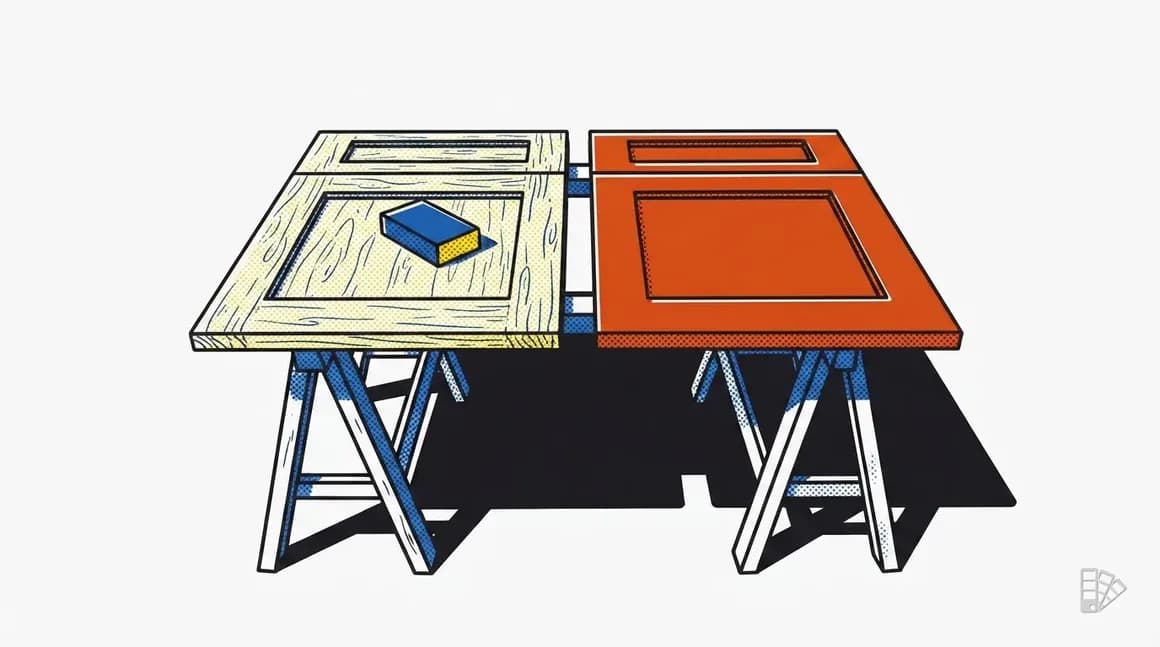
Side by Side: Refinish, Paint, Reface
Every factor that moves the decision, on one screen. Costs assume a professional crew on a standard 10x10 kitchen in a mid-cost US market as of 2026; a metro labor rate pushes each range up 20–35%. Sheen choice matters more than most homeowners expect on cabinets — see the paint sheen guide for why satin and semi-gloss dominate cabinet work.
| FACTOR | REFINISH | PAINT | REFACE |
|---|---|---|---|
| Cost (10x10 kitchen) | $2,000 – $5,500 | $1,800 – $4,500 | $4,500 – $10,000 |
| Cost per linear foot | $65 – $160 | $60 – $135 | $150 – $450 |
| Timeline on site | 5 – 8 days, plus cure | 4 – 7 days, plus cure | 3 – 5 days, little cure |
| Kitchen out of service | Doors off ~1 week; sink usable | Doors off ~1 week; sink usable | 1 – 2 days of real disruption |
| Durability | 10 – 15 yrs with a catalyzed topcoat | 8 – 12 yrs sprayed; 5 – 7 brushed | 15 – 20 yrs on the new doors |
| Final look | Wood grain, new stain tone | Opaque color, grain muted | New door style and material |
| Works on | Solid wood and thick veneer only | Wood, MDF, laminate, thermofoil, metal | Any box that is square and sound |
| Color freedom | Same tone or darker; lighter needs bleach | Any color in the fan deck | Any color or species you order |
| DIY difficulty | Hard — stripping, sanding, spray finishing | Moderate — prep is 70% of the work | Pro only — veneer and door hanging |
| Mess and dust | Heavy — chemical stripper and sanding dust | Moderate — sanding dust, overspray control | Light — mostly adhesive and offcuts |
| Resale appeal | Strong in wood-forward kitchens | Strongest — white and greige photograph well | Strong, but buyers open a door and see old boxes |
| Reversible later? | Yes — can be painted afterward | Only by stripping back to bare wood | No — the old doors are gone |
Which One Fits Your Cabinets?
Work down these five questions in order. Each one either eliminates an option or sends you to the next, and most kitchens resolve by question three. Answer honestly about the boxes — a coat of anything on a water-damaged sink base is money set on fire.
Are the boxes worth keeping?
Open a door and press the shelf. Look under the sink for swelling.
Soft, swollen, or racked boxes; sagging shelves
REPLACENo finish and no new door fixes a box that has failed. Stop here.
Square, dry, doors close flush
NEXT QUESTIONEverything below is on the table.
Do you like the door style?
Style is the shape — raised panel, shaker, slab, cathedral arch.
The shape has to go, or doors are warped or delaminated
REFACENew doors are the only path to a new profile. Skip the rest.
The shape is fine, the color is the problem
NEXT QUESTIONNow the question is what the doors are made of.
What are the doors actually made of?
Check the inside edge of a door, not the face.
MDF, particleboard, laminate, or thermofoil
PAINTThere is no wood to re-stain. Bonding primer and enamel, or reface.
Solid wood, or veneer thick enough to sand
NEXT QUESTIONBoth refinishing and painting are open to you.
What is on them now?
Stain plus a clear topcoat, or an opaque coating?
Already painted or factory-coated opaque
PAINTGetting back to bare wood under old enamel is rarely worth the labor.
Stained and clear-coated wood
NEXT QUESTIONThis is the only starting point that can truly be refinished.
What look do you want to end up with?
This is the last fork, and it is purely taste.
White, greige, navy, green — any solid color
PAINTStain cannot make a light or saturated color. Paint can.
Wood grain, just a different or fresher tone
REFINISHStrip, re-stain, and topcoat. Going lighter means bleaching first.
THE 10-SECOND MATERIAL TEST
Take one door off and look at the inside edge, near a hinge cup. Solid wood shows continuous end grain that runs through the edge. Veneer shows a thin face layer over a core with a visible glue line. MDF looks like dense brown cardboard. Thermofoil is a vinyl film with a seam you can catch with a fingernail — and if a corner is already peeling near the range, that door will never take a stain and is marginal even for paint.
Cost Example: A 10x10 Kitchen
The 10x10 kitchen is the industry's standard yardstick — roughly 30 linear feet of cabinetry — so it is the fairest way to compare quotes that use different units. Some contractors price per door, some per linear foot, some per square foot of door face. All three land in the same neighborhood once you normalize them.
THE KITCHEN WE ARE PRICING
A standard 10x10 kitchen: roughly 20 linear feet of base cabinet and 10 linear feet of wall cabinet, which works out to about 30 doors and 8 drawer fronts — 38 pieces to handle, hang, and coat twice on both faces. Every number below assumes that count. Add or subtract roughly $55–$120 per extra door for painting and $70–$150 for refinishing.
INSTALLED COST RANGE
Paint (pro sprayed)
$1,800 – $4,500
Degrease, sand, bonding primer, two coats of enamel, doors sprayed off-site
Refinish (pro)
$2,000 – $5,500
Strip, sand to bare, stain, two coats of catalyzed clear
Reface
$4,500 – $10,000
New doors and drawer fronts, veneer over face frames, new hinges
Replace (stock/semi-custom)
$9,000 – $26,000
Tear-out, new boxes, install, plus countertop removal and refit
Scale 0 – $16,000 · typical US ranges as of 2026 · replace bar runs off the chart
IF YOU PAINT THEM YOURSELF
Materials only, for the same 38-piece kitchen. Budget 35–50 working hours across roughly two weekends plus evenings.
- Degreaser, tack cloths, sandpaper (120/180/220)$55 – $90
- Shellac or waterborne bonding primer (2 gal)$90 – $150
- Cabinet enamel (2 gal of a waterborne alkyd)$110 – $200
- Wood filler, caulk, sanding blocks, rags$40 – $70
- Plastic sheeting, tape, drop cloths, door racks$60 – $120
- HVLP or fine-finish sprayer rental (3 days)$120 – $220
- New hinges and pulls (38 pieces)$150 – $450
55–70%
of a pro cabinet quote is labor, almost all of it prep
$70–$150
typical per-door price pros quote for cabinet painting
14–30
days a waterborne enamel needs to fully cure and harden
PRICE YOUR KITCHEN
Enter your door and drawer count, box linear feet, and finish level to get a real number instead of a national average — and a per-door figure you can hold a contractor's quote against.
What Each Job Actually Involves
Step counts look similar on paper. The difference is where the hours go: refinishing spends them on removal, painting spends them on adhesion, refacing spends them on measurement. Doors get sprayed flat on racks in every case worth paying for — read how to use a paint sprayer before you rent one, and oil-based vs latex paint for why waterborne alkyds took over cabinet work. If a previous coat is already lifting, fix that first with how to fix peeling paint.
Kitchen grease is the number one cause of cabinet paint failure. Degrease before you sand, not after.
- 01
Degrease everything twice
3–4 hrsTSP substitute or a dedicated cabinet degreaser, rinse, dry. Around the range and the trash pull, do it a third time.
- 02
Label, remove, and set up a spray area
3 hrsDoors on racks or blocks, laid flat, in a space you can ventilate and keep at 65–75°F.
- 03
Fill, caulk, and scuff-sand
1 day220 grit until the sheen is dead flat. Fill old hardware holes if pull spacing changes. Grain-fill oak now if you want a smooth finish.
- 04
Bonding primer
1 dayShellac-based over stained wood, tannin-heavy oak, or thermofoil. Waterborne bonding primer on MDF and previously painted doors. One coat, sanded with 320.
- 05
Two coats of cabinet enamel
1–2 daysA waterborne alkyd sprayed through a fine-finish tip. Four hours between coats minimum; sand lightly between them.
- 06
Cure before you rehang hard
2–4 weeksRehang after 24–48 hours but treat the surface gently for 2–4 weeks. Felt bumpers keep doors from sticking to frames while the film hardens.
The Bottom Line
THE RULE
Refinish when the wood is the point.
Paint when the color is the point.
Reface when the door is the point.
The material decides first and taste decides second. If your doors are MDF, laminate, or thermofoil, refinishing was never an option no matter what the salesperson called it. If they are solid oak you want to keep reading as oak, paint is the wrong tool even though it is cheaper.
70%
of a cabinet job is prep — degrease, sand, prime
38
doors and drawer fronts in a typical 10x10 kitchen
2–3x
what refacing costs versus painting the same kitchen
Priced it and landed on paint? Run your kitchen through the cabinet painting cost calculator for a per-door number, then pick a product with the best paint for cabinets guide and work through the full kitchen cabinet painting process. If the rest of the room is going too, the interior painting cost calculator covers walls, ceilings, and trim in the same budget.
Frequently Asked Questions
RELATED TOOLS & GUIDES
Cabinet Painting Cost Calculator
Price your kitchen by door count, box linear feet, and finish level.
GUIDEHow to Paint Kitchen Cabinets
The full prep-to-cure process, including the degreasing step most people skip.
GUIDEBest Paint for Cabinets
Which enamels actually hold up to fingernails, grease, and cabinet doors slamming.
GUIDEHow to Use a Paint Sprayer
Tip sizes, thinning, and passes for a factory-flat finish on doors.
COMPARISONOil-Based vs Latex Paint
Why waterborne alkyds replaced true oil enamel on cabinet work.