OIL-BASED VS LATEX PAINT
Oil lays down glass-smooth and cures rock hard. Latex stays flexible, dries in an hour, and washes off your hands. And a third family — waterborne alkyd — now does most of both jobs at once. Here is what actually belongs on your trim, doors, cabinets, and siding.
Quick Verdict
For almost every job in a house today, the answer is water-based — but not always the same water-based paint. Use acrylic latex on walls, ceilings, and exterior siding. Use a waterborne alkyd on trim, doors, and kitchen cabinets, because those surfaces need oil-grade leveling and a hard film. Save traditional oil-based alkyd for metal, radiators, and stain-blocking primer under tannin-heavy wood.
OIL-BASED ALKYD
Best for: Metal railings, heat radiators, tannin-heavy woods, older trim you are only touching up
- Levels out brush and roller marks better than anything else
- Cures by oxidation to a hard, dense film that resists dents
- Blocks tannin and water stains bleeding through from below
- Sticks to chalky, slick, and marginally prepped surfaces
- Ambers and yellows over time — worst on whites in dark rooms
- 16–24 hours between coats, so a trim package eats three days
- Solvent odor and high VOCs; needs mineral spirits to clean up
- Gets brittle with age and cracks where wood moves seasonally
ACRYLIC LATEX
Best for: Walls, ceilings, exterior siding, and any room you need back in service today
- Recoat in 2–4 hours — a full room in one working day
- Stays flexible, so it moves with wood instead of cracking
- Does not yellow; whites stay white for the life of the coat
- Soap-and-water cleanup, low odor, low VOC everywhere
- Shows brush marks and stipple unless you keep a wet edge
- Softer film — blocks (sticks to itself) on doors and sills
- Takes 14–30 days to reach full hardness after it feels dry
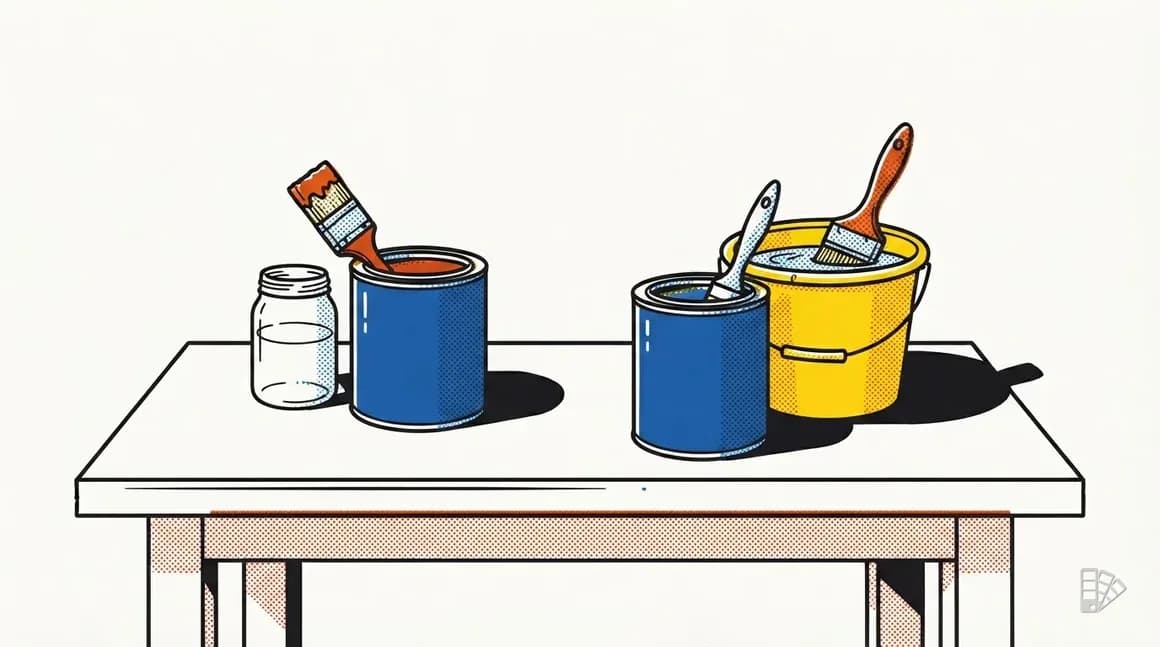
The Three Families of Paint
The phrase “oil vs water based paint” is a leftover from when there really were only two choices. There are three now, and the third one is why the argument mostly ended. What separates them is the binder — the resin that forms the film — and the carrier that delivers it to the surface.
TRADITIONAL ALKYD
Also sold as: oil-based, oil enamel, solvent-borne
- Binder
- Alkyd resin
- Carrier
- Mineral spirits
- How it cures
- Oxidation — pulls oxygen from the air for about a week
The old-school enamel. Because the solvent evaporates slowly, the film stays open long enough to flow flat, which is why a brushed oil door can look sprayed. That same oxidation keeps going for years, which is exactly why it ambers and eventually turns brittle.
Sold mostly in quart cans and industrial lines as of 2026
ACRYLIC LATEX
Also sold as: water-based, waterborne acrylic, vinyl-acrylic
- Binder
- Acrylic polymer
- Carrier
- Water
- How it cures
- Coalescence — particles fuse as water leaves, then keep hardening
No actual latex rubber involved; the name stuck from the original emulsion paints. 100% acrylic binders own the exterior market because the film flexes with every seasonal wood movement instead of cracking, and they hold color against UV far better than alkyds.
The default for walls, ceilings, and siding
WATERBORNE ALKYD
Also sold as: hybrid, urethane alkyd, alkyd emulsion
- Binder
- Alkyd (often urethane-modified) emulsified in water
- Carrier
- Water
- How it cures
- Coalesces like latex, then oxidizes hard like an alkyd
Alkyd resin chopped fine enough to suspend in water. You get oil-grade flow and leveling and a hard enamel film, with soap-and-water cleanup and low VOCs. Trade-off: a long recoat window (commonly around 16 hours) and a slow march to full hardness — rush it and you will print the film with your fingerprints.
Benjamin Moore Advance, Sherwin-Williams Emerald Urethane Trim Enamel, plus urethane-alkyd enamels from the big-box brands
PRO TIP — READ THE BINDER, NOT THE MARKETING
Labels lean on words like “enamel” and “advanced” that mean nothing chemically. Enamel just implies a hard finish. Flip to the technical data sheet and look for the resin — alkyd, acrylic, or urethane alkyd — and the cleanup instructions. Those two lines tell you everything the front of the can will not.
Feature-by-Feature Comparison
Every metric that changes the decision, all three families side by side. Sheen is deliberately absent — all three come in the full range, and picking one is a separate call covered in our paint sheen guide.
| FEATURE | OIL-BASED ALKYD | ACRYLIC LATEX | WATERBORNE ALKYD |
|---|---|---|---|
| Durability | Hardest film of the three; shrugs off dents and door-latch wear | Good on walls, softer on trim — can block and scuff | Near-oil hardness once fully cured; the trim standard |
| Leveling / brush marks | Best in class — flows flat, hides brush strokes | Shows stipple and lap marks unless you keep a wet edge | Levels almost like oil; extenders help in warm rooms |
| Dry & recoat time | Tack-free 6–8 hrs, recoat 16–24 hrs, cures ~7 days | Tack-free 30–60 min, recoat 2–4 hrs, cures 14–30 days | Tack-free 4–6 hrs, recoat ~16 hrs, cures 5–7 days |
| Yellowing | Ambers with age — obvious on whites in low-light rooms | None; whites stay white | Minimal — far more color-stable than traditional oil |
| Odor & VOC | Strong solvent odor, highest VOC of the three | Low odor, low VOC — many lines under 50 g/L | Low odor and low VOC, with a faint alkyd smell while curing |
| Cleanup | Mineral spirits; brushes and rags need proper disposal | Soap and water | Soap and water |
| Flexibility / cracking | Stiffens with age; cracks where wood expands and contracts | Stays flexible — the reason it owns exterior siding | Harder than latex but formulated to resist brittleness |
| Cost per gallon (2026 range) | $45–$80 where still stocked, often quart-only | $30–$70 for quality interior and exterior lines | $55–$95 — the premium tier of trim enamels |
| Availability | Shrinking; restricted container sizes in many regions | Everywhere, every sheen, every brand | Every major brand carries at least one line |
Dry and recoat times assume roughly 70°F and 50% relative humidity. Cold or damp conditions stretch every number in this table.
Dry Time, Recoat Time, and Cure Time
Three different clocks get confused constantly. Tack-free means dust stops sticking. Recoat means the film can accept another coat without lifting. Cure means the paint has reached full hardness and chemical resistance. Latex wins the first two by a mile and loses the third badly.
DRY, RECOAT, AND CURE — SIDE BY SIDE
Manufacturer-typical figures at 70°F and 50% humidity. Each panel is scaled on its own — compare bars within a panel, not across them.
TACK-FREE
How long until dust stops sticking
RECOAT WINDOW
Earliest you can lay the second coat
FULL CURE
Before you scrub it or set objects on it
THE TRAP MOST PEOPLE MISS
Latex recoats fastest and cures slowest. A latex-painted window sash feels dry in an hour but can still glue itself shut two weeks later. Oil and waterborne alkyd flip that: slow to recoat, hard sooner. On doors, drawers, and sashes, cure time matters more than dry time.
Temperature moves all of these numbers. Below about 50°F, standard latex cannot coalesce properly and dries to a powdery, weak film, while oil-based paint thickens and can stay tacky for days. If you are working through a cold snap, read our guide to painting in cold weather before you open the can — some acrylics are rated down to 35°F, most are not.
Where Each One Still Wins
Binder choice is a surface-by-surface decision, not a house-wide one. A typical repaint uses acrylic latex on 90% of the square footage and a hybrid enamel on the 10% everyone actually touches.
Pick a surface to see what belongs on it:
TRIM & BASEBOARDS
HYBRID WINSWaterborne alkyd, semi-gloss
Trim is judged from two feet away, so leveling wins. A waterborne alkyd flows out the brush marks that latex leaves behind and cures hard enough to survive a vacuum cleaner. Plan one coat per day — the long recoat window is the price of that finish.
How to paint trim and baseboardsHow to Paint Over Oil-Based Paint
This is where most projects in older homes go wrong. Water-based paint has no chemical grip on a cured, glossy alkyd film — it sits on top like a sticker. Skip the prep and the failure shows up months later as sheets of paint lifting off a door edge, which is the same mechanism behind most peeling paint problems. Six steps, in order, and none of them are optional.
THE 30-SECOND ALCOHOL TEST
PAINT COMES OFF ON THE COTTON
Water-based. Scuff-sand, spot-prime any bare areas, and paint. No bonding primer required.
COTTON STAYS CLEAN
Oil-based (or a fully cured hard enamel). Degloss and use a bonding primer before any water-based topcoat.
- 01
Test the surface first
Soak a cotton ball or white rag in denatured alcohol (isopropyl rubbing alcohol or acetone also work), then rub hard on a hidden spot for 15–20 seconds. Color transfers or the finish gets gummy? It is water-based. Cotton stays clean? Treat it as oil-based. Test every surface separately — it is common to find oil trim in a house with latex walls.
- 02
Degrease before you sand
Sanding grease just drives it into the pores. Wash with a TSP substitute or a strong household degreaser, rinse with clean water, and let the surface dry fully. Kitchens, bathrooms, and any home with a smoker need this step twice.
- 03
Degloss with 180–220 grit
You are not stripping paint, only killing the sheen so the primer has tooth. Sand until the whole surface reads dull and uniform, then vacuum and wipe with a tack cloth. A liquid deglosser is an option on carved profiles and spindles you cannot reach with paper.
- 04
Prime with a real bonding primer
This is the step people skip, and it is the reason latex peels off oil trim in sheets a year later. Use a product that says bonding or adhesion on the label — a shellac primer like Zinsser B-I-N, or a waterborne bonding primer such as Insl-x Stix or Sherwin-Williams Extreme Bond. One full coat is usually enough; give it the stated dry time before topcoating.
- 05
Topcoat with latex or waterborne alkyd
Two thin coats beat one heavy one every time. On trim, doors, and cabinets, a waterborne alkyd over the bonding primer gets you the oil look without ever opening a can of mineral spirits. Respect the recoat window on the label rather than the feel of the surface.
- 06
Let it cure before you load it
The film keeps hardening long after it feels dry. Keep painter's tape off fresh trim, leave doors ajar, and wait at least a week before setting anything on a painted sill or scrubbing the surface.
WATCH OUT — HOMES BUILT BEFORE 1978
If the oil-based coating is original to a pre-1978 home, assume lead until it is tested. Dry sanding lead paint puts dust through the whole house, and contractors working on those surfaces need RRP certification. See our lead paint certification guide before you pick up a sander.
VOC Rules and Availability
If your local store stopped stocking gallon cans of oil enamel, VOC regulation is why. Nothing here is legal advice and the specifics differ by state, but understanding the shape of the rules explains what you will and will not find on the shelf — and why hybrids took over the trim aisle.
What the number on the label means
VOC content is printed in grams per liter. Solvent-borne alkyds sit at the high end of the scale because the carrier itself evaporates into the air; most modern interior latex and waterborne alkyd lines are engineered well under the limits, and plenty advertise under 50 g/L. If a can does not list its VOC content, the technical data sheet on the manufacturer's site will.
Why the shelf looks different than it did
There is no nationwide ban on oil-based paint. What exists is a stack of rules — a federal baseline for architectural coatings, plus stricter state and regional limits, notably in California and several Northeastern states. Small containers are commonly exempt, which is why oil enamel often survives as quart cans while the gallons disappear. Rules differ by state and get revised, so treat availability as a local question and confirm with a paint store near you.
The part that actually hurts people
Rags soaked in oil-based paint or solvent generate heat as they oxidize and can self-ignite in a wadded pile. Lay them flat outdoors to dry, or seal them in a metal can with water. Leftover solvent-borne paint and used mineral spirits are usually household hazardous waste, not trash. Latex has none of these problems, which is a real cost difference on a job site.
Regulatory summary as of 2026 and written in general terms — it is not legal advice. Check your state environmental agency or your paint supplier for the limits that apply to your address.
The Bottom Line
THE RULE
Latex on anything that moves.
Hybrid enamel on anything that gets touched.
Oil only where nothing else works.
Walls, ceilings, and siding are acrylic latex work — flexible, fast, color-stable. Trim, doors, and cabinets belong to waterborne alkyd, which buys you oil-grade leveling and hardness without the yellowing or the solvent. Traditional oil earns its keep on metal railings, radiators, and as a stain-blocking primer under tannin-rich wood. That is the entire decision.
16–24h
oil recoat window vs 2–4 hours for latex
14–30d
for latex to reach full hardness after it feels dry
1 coat
of bonding primer is what keeps latex on old oil trim
Picking a product next? Start with the best paint for trim for named enamel recommendations, or run the numbers on the whole job with our interior painting cost calculator.
Frequently Asked Questions
RELATED TOOLS & GUIDES
Best Paint for Trim
Named enamel picks once you have settled the oil-versus-water question.
GUIDEBest Paint for Cabinets
Which coatings survive greasy hands and daily door slams.
GUIDEPaint Sheen Guide
Flat through high-gloss, and what each finish is actually for.
COMPARISONCabinet Refinishing vs Painting
Two very different jobs with very different price tags.
FREE TOOLPaint Calculator
Gallons needed for your walls, trim, and ceilings.